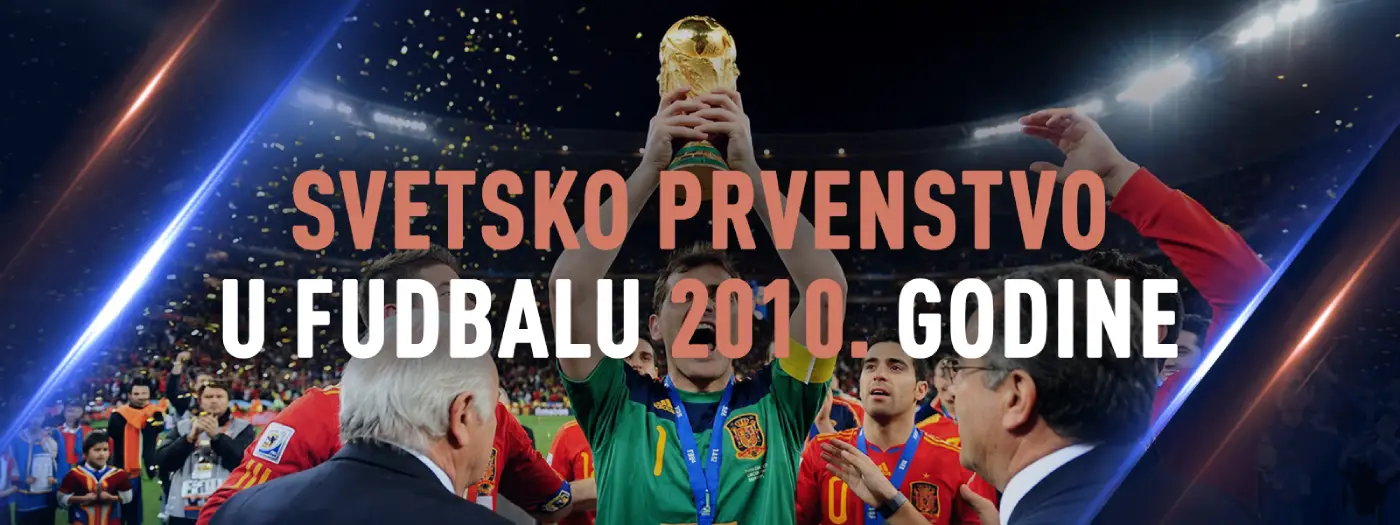
FIFA World Cup 2010
The 2010 FIFA World Cup was held in South Africa from June 11 to July 11 and was the 19th edition of the tournament. It was the first World Cup to be hosted on the African continent, giving it strong symbolic and historical significance.
The 2010 World Cup is remembered for its unique stadium atmosphere, the sound of vuvuzelas that became a defining feature of television broadcasts around the world, and Spain’s tactically disciplined style of play, which ultimately led the team to its first World Cup title. The tournament demonstrated how football had become a truly global platform, extending beyond sport into the cultural and political spheres.
Historical and Organisational Context
South Africa was awarded the right to host the tournament in 2004, as part of FIFA’s continental rotation system in place at the time. Hosting the World Cup carried enormous symbolic significance, as Africa was given the opportunity to host the world’s biggest football tournament for the first time.
Matches were played across 10 stadiums in nine host cities: Johannesburg, which had two venues, Cape Town, Durban, Pretoria, Rustenburg, Polokwane, Nelspruit, Bloemfontein and Port Elizabeth. The final was played at Soccer City in Johannesburg before a crowd of more than 84,000 spectators.
The tournament had a significant social impact on the host country. Although there had been concerns about logistical readiness and security preparedness, the tournament was staged without major organisational problems, further strengthening South Africa’s international reputation.
Qualifying and Tournament Participants
A total of 204 national teams took part in the qualifying process, representing almost all FIFA member associations at the time. The final tournament retained the 32-team format, with the teams divided into eight groups of four.
As hosts, South Africa qualified automatically, while the other teams went through a multi-year qualifying campaign. Europe was allocated 13 places, Africa six, Asia four, South America four, and North and Central America three, with additional playoff matches determining the remaining places.
The tournament brought together a generation of players who had already won major European club competitions and made their mark on the international stage. Spain entered the tournament as the reigning European champions after winning UEFA Euro 2008, while Brazil were among the traditional favourites.
The Host Nation and Tournament Organisation
Hosting the tournament involved the construction of new stadiums and the modernisation of existing infrastructure. Soccer City in Johannesburg was renovated to become the centrepiece of the World Cup, while Cape Town Stadium was built as one of the tournament’s most recognisable architectural landmarks.
The atmosphere inside the stadiums was unique. The sound of the vuvuzelas became one of the defining symbols of the tournament. Although they received mixed reactions, their distinctive sound gave the World Cup an authentic character and made it unlike any previous edition.
The 2010 World Cup
Tournament Format
The tournament followed the same format as previous editions: 32 teams were divided into eight groups, with the top two teams in each group advancing to the Round of 16.
In the knockout stage, matches went to extra time if the scores were level after 90 minutes, followed by a penalty shootout if the winner could not be decided after extra time.
Group Stage
The group stage produced several unexpected results. Defending champions Italy were eliminated in the group stage without winning a match. France were also eliminated at the same stage, with internal conflicts and disciplinary problems overshadowing their campaign.
Spain began the tournament with a 1–0 defeat to Switzerland but quickly recovered and secured a place in the knockout stage. Germany demonstrated their attacking efficiency with a 4–0 victory over Australia.
Uruguay emerged as one of the surprise packages of the group stage, while hosts South Africa became the first host nation in World Cup history to fail to advance from the group stage.
The Knockout Stage and Key Moments
The Round of 16 produced several significant matches. Germany defeated England 4–1 in a match overshadowed by Frank Lampard’s disallowed goal, even though the ball had clearly crossed the goal line. The incident was one of the key moments that fuelled calls for the introduction of goal-line technology.
In the quarterfinals, Spain defeated Paraguay 1–0, while the Netherlands eliminated Brazil with a 2–1 comeback victory.
Uruguay reached the semifinals, where they were defeated by the Netherlands, while Spain overcame Germany 1–0 in the other semifinal thanks to a header from Carles Puyol.
The Final and the Battle for the Title
The final was played on July 11, 2010, between Spain and the Netherlands. The match was an extremely physical and tactically cautious affair, featuring a large number of fouls and yellow cards.
With the score still level after 90 minutes, Andrés Iniesta scored the decisive goal in the 116th minute of extra time, giving Spain their first World Cup title.
The Netherlands finished the match with 10 men after Johnny Heitinga was sent off.
The Tournament’s Standout Players
Spain’s midfield, led by Xavi, Andrés Iniesta and Sergio Busquets, formed the foundation of the team’s tactical dominance. Iker Casillas made several crucial saves during the knockout stage, including a decisive save in the final.
Thomas Müller finished among the tournament’s leading scorers with five goals, while Diego Forlán was one of the standout players of the competition, leading Uruguay to the semifinals.
Statistics and Interesting Facts
The tournament featured 64 matches and produced 145 goals, making it one of the lower-scoring World Cups of the modern era.
The 2010 World Cup was the first edition to be held on African soil and remains a symbol of Africa’s growing recognition on the global football stage and the worldwide reach of the sport.
The Legacy of the 2010 World Cup
The 2010 World Cup represented a turning point in both geographical and symbolic terms. The tournament demonstrated that football transcends cultural and political boundaries and that the World Cup has the power to shape the way the sport is perceived around the world.
The World Cup in South Africa is remembered as a tournament defined by tactical discipline, historical importance and a unique atmosphere that set it apart from previous editions. The Spanish generation that won the country’s first World Cup title remained at the centre of attention at the next tournament, the 2014 World Cup.