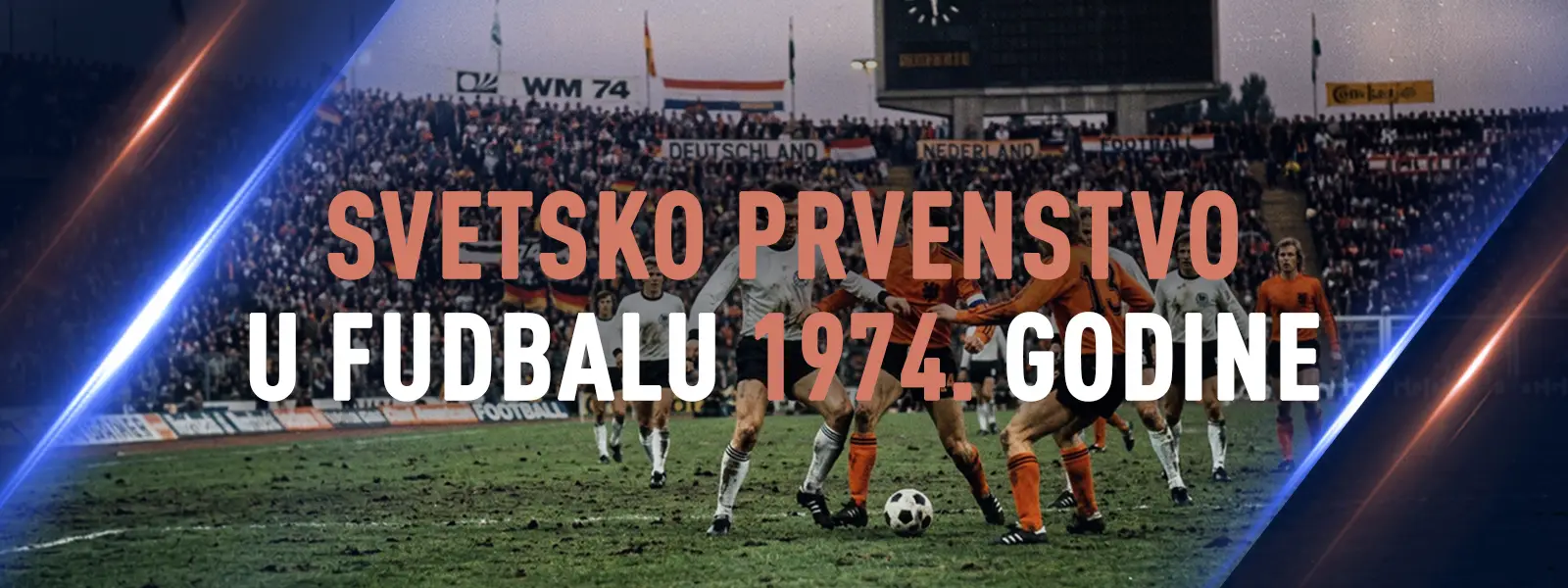
FIFA World Cup 1974
The 1974 FIFA World Cup was held in West Germany from June 13 to July 7 and was the 10th edition of the tournament. The competition had significant symbolic importance: it was the first World Cup held in the Federal Republic of Germany, but also a tournament that came at a time when international football had already entered a phase of full professionalization and tactical maturity.
The 1974 World Cup is often viewed as a turning point in the development of the modern game. It confirmed new ideas in football, highlighted the importance of collective organization and showed that an aesthetically appealing style of play does not necessarily have to be the decisive factor in achieving success at the highest level.
Historical and Footballing Context
The early 1970s were marked by political divisions and economic challenges, as well as significant social and technological changes across Western Europe. West Germany was one of the continent’s leading economic powers at the time, with well-developed infrastructure and strong sporting institutions, making it a logical and organizationally viable choice to host the World Cup.
On the footballing front, the sport had entered a phase of increasing tactical sophistication. Systematic training, physical preparation and clearly defined player roles had become key elements of success. Differences between national teams were no longer reflected solely in technical quality, but also in their ability to consistently implement complex tactical ideas on the pitch.
The 1974 World Cup was inextricably linked to the concept of “Total Football”, which at the time represented the pinnacle of modern tactical thinking.
Qualifying and Participating Teams
An exceptionally large number of national teams entered the qualifying process for the 1974 World Cup, continuing the trend of growing global interest in the tournament. Through the qualifying process, 16 teams secured their places at the final tournament in West Germany, with the hosts and reigning world champions Brazil receiving automatic qualification.
The final tournament brought together national teams from different parts of the world, with strong representation from European sides. The qualifying process once again highlighted the existing differences between continents, but also the gradual expansion of the pool of competitive teams on the international stage.
Host Country and Tournament Organization
Matches at the 1974 World Cup were played in nine cities across West Germany, including Munich, Hamburg, Frankfurt, Dortmund, Gelsenkirchen, Stuttgart, Hanover, Düsseldorf and West Berlin. The final was played in Munich at the Olympic Stadium, one of the tournament’s central and symbolic venues.
The tournament was organized to a high standard, with modern infrastructure and well-developed logistics. The stadiums built or extensively renovated for the tournament symbolized a modern approach to organizing major sporting events, while spectator interest remained steady throughout the competition.
The 1974 World Cup further established standards for television broadcasting and the visual presentation of football, giving the tournament a distinctive modern identity.
The Course of the 1974 World Cup
Tournament Format
The tournament had a distinctive structure compared with previous World Cups. The 16 national teams were divided into four groups in the first stage, after which the top two teams from each group advanced to a second group stage instead of a direct knockout round.
In the second stage, the eight teams were divided into two groups of four. The group winners advanced to the final, while the runners-up played in the third-place match. This format placed particular emphasis on consistency and tactical stability throughout the tournament, but was later abandoned because of its complexity and reduced clarity for spectators.
Group Stages
The first group stage featured a combination of expected results and several surprises. It became clear even at this stage of the tournament that tactical discipline would play a decisive role.
The second group stage produced matches of exceptional intensity and tactical battles. It was during this stage that national teams representing different footballing philosophies faced each other directly, giving the tournament additional depth and complexity.
The Final Stages
As there was no traditional knockout stage before the final, the decisive matches in the second group stage had an almost knockout-like character. Every mistake had immediate consequences, further increasing the competitive pressure.
The teams that managed to maintain stability and discipline within this system gained a clear advantage over their rivals. This aspect is often cited as one of the reasons why the 1974 tournament was so tactically oriented and had a slower pace compared with some earlier World Cups.
The Final and the Fight for the Title
The 1974 World Cup final was played on July 7 in Munich. West Germany faced the Netherlands in a match that symbolized a clash between two footballing philosophies.
The Netherlands took the lead early in the match, but West Germany managed to turn the game around and win 2–1. With this victory, the hosts claimed their second World Cup title.
The match is remembered as one in which the result did not fully reflect the overall impression of the game, further fueling long-standing debates about the relationship between aesthetic value and competitive efficiency.
The Tournament’s Standout Players
The 1974 World Cup featured several outstanding individuals, but the tournament was largely remembered for its collective ideas and team concepts.
The Netherlands attracted particular attention for their style of play, based on constant positional rotation, high pressing and technical quality, which became the subject of numerous analyses and had a lasting influence on the development of modern football.
The tournament’s top scorer was Poland’s Grzegorz Lato, who scored seven goals and played a key role in helping his team finish third. Gerd Müller, meanwhile, scored four goals for West Germany, including the decisive goal in the final.
Statistics and Interesting Facts
A total of 38 matches were played at the 1974 World Cup, with 97 goals scored. The average number of goals per match was lower than at the 1970 tournament, reflecting the more defensively mature and tactically disciplined nature of the competition.
The tournament is also remembered for the introduction of a new World Cup trophy, which replaced the Jules Rimet Trophy after Brazil permanently retained it four years earlier.
The Place of the 1974 World Cup in Football History
The 1974 World Cup holds a special place in football history as a tournament that marked the shift toward a modern, organized and tactically sophisticated approach to the game. It showed that achieving top-level results requires a system, structure and collective discipline.
At the same time, the World Cup in West Germany became a lasting symbol of the debate over what makes “the right” way to play football – aesthetic appeal or competitive efficiency. This dilemma makes the 1974 World Cup one of the most frequently analyzed and interpreted tournaments in the history of the sport. Four years later, this footballing story continued at the 1978 World Cup, which ushered in a new era of major international clashes.