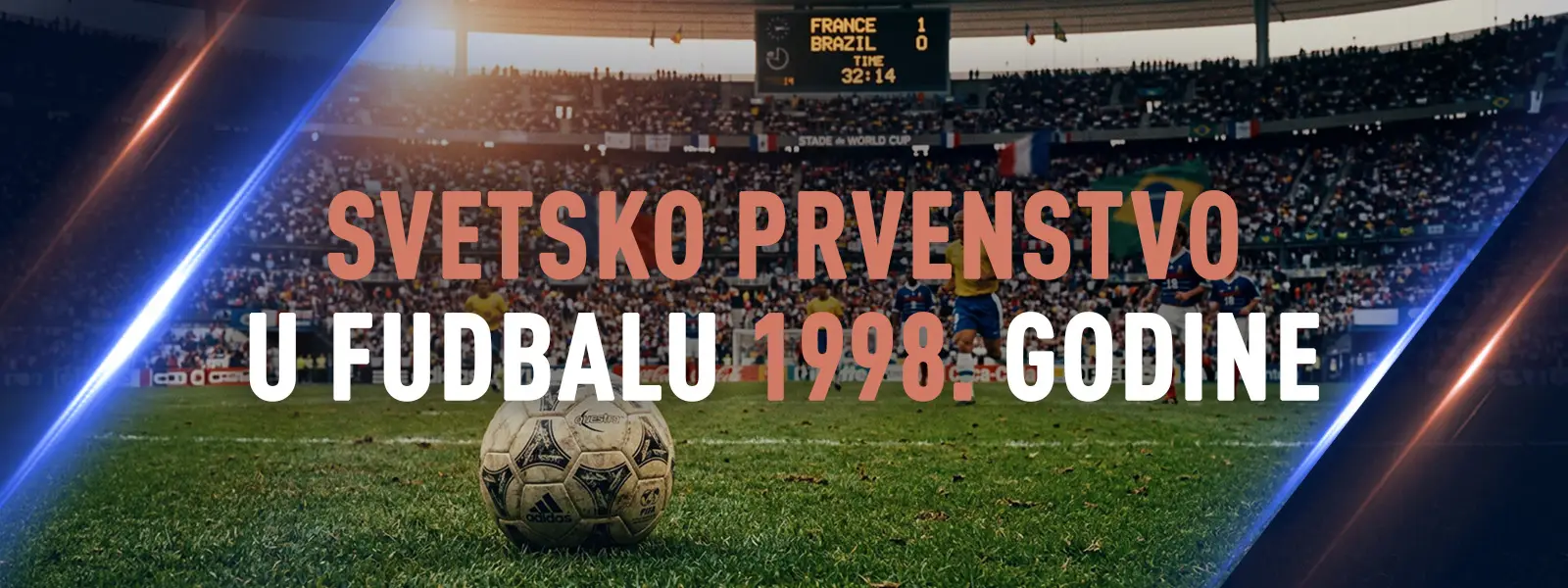
FIFA World Cup 1998
The 1998 FIFA World Cup was held in France from June 10 to July 12 and was the 16th edition of the tournament. The competition was particularly significant from a historical perspective, as it was the first World Cup to feature 32 teams, establishing a format that would remain in place for the next two decades.
The World Cup in France is remembered for its technically accomplished football, a strong home side and a final that marked the beginning of a new era in French football.
Historical and Social Context
As Europe entered a period of greater stability and integration in the late 1990s, France sought to reinforce its position as one of the continent’s leading sporting and cultural powers by hosting the World Cup.
The French national team came to symbolise the country’s multicultural society, giving the tournament a broader symbolic dimension. A team made up of players from diverse backgrounds became a wider social phenomenon during the competition.
Qualifying and Tournament Participants
The expansion to 32 teams allowed for greater representation from Africa, Asia and North America. A record 174 national teams entered the qualifying process, with 168 of them actually taking part in qualifying matches.
The final tournament featured teams from all inhabited continents, with hosts France and defending champions Brazil qualifying automatically. The 32-team format became the foundation for subsequent World Cups, most notably the 2002 World Cup, which took the tournament to Asia for the first time.
The Host Nation and Tournament Organisation
Matches were played across ten French cities, including Saint-Denis (Stade de France), Marseille, Lyon, Bordeaux, Nantes, Toulouse, Saint-Étienne, Lens, Montpellier and a further venue in the Paris region. The final was played at the Stade de France in Saint-Denis, which had been built specifically for the tournament.
The organisation of the World Cup was widely regarded as successful, while infrastructure and security standards were significantly improved compared with previous tournaments.
The 1998 World Cup
Tournament Format
With 32 teams taking part, the tournament featured eight groups of four. The top two teams from each group advanced to the Round of 16, meaning the knockout stage began with 16 teams.
This format provided greater clarity and competitive balance compared with the previous 24-team format.
Group Stage
The group stage produced a series of entertaining matches and several memorable moments. Defending champions Brazil demonstrated consistency, while several European teams confirmed the continued improvement in quality across the continent.
The tournament was also marked by several incidents, most notably David Beckham’s red card in the Round of 16 against Argentina. The match ended 2–2, with Argentina advancing to the quarterfinals after a penalty shootout.
The Knockout Stage and Key Moments
The knockout stage produced a series of dramatic encounters. The quarterfinal between the Netherlands and Argentina ended in a 2–1 victory for the Netherlands, while France eliminated Italy on penalties.
In the semifinals, France faced Croatia, with the hosts coming from behind to secure their place in the final, while Brazil defeated the Netherlands in a penalty shootout.
Croatia, making their first appearance as an independent nation at the World Cup, achieved an outstanding result by finishing third.
The Final and the Battle for the Title
The 1998 World Cup final was played on July 12 at the Stade de France in Saint-Denis. France defeated Brazil 3–0 to win their first World Cup title.
Zinedine Zidane scored twice in the final, while Emmanuel Petit scored the third. The final was also remembered for the controversy surrounding Ronaldo’s health. The Brazilian forward suffered a seizure several hours before the match, was initially left out of the starting XI and was then reinstated shortly before kick-off.
The Tournament’s Standout Players
Zinedine Zidane was one of the tournament’s defining figures, particularly during the latter stages of the 1998 World Cup. His performance in the final remains one of the most significant individual displays in World Cup history.
Davor Šuker finished as the tournament’s leading scorer with six goals, becoming the first Croatian player to win the Golden Boot.
Statistics and Interesting Facts
The tournament featured 64 matches and produced 171 goals. The average number of goals per match was relatively high despite the increased number of participating teams.
The 1998 World Cup is remembered as a tournament that confirmed the success of the 32-team format and ushered in a new era for the World Cup.
The Legacy of the 1998 World Cup
The 1998 World Cup represented a turning point in the modern history of football. It established the 32-team format as the standard, reinforced the global character of the game and gave emerging national teams an opportunity to achieve historic success.
The tournament in France remains a symbol of a new generation of football and the beginning of a modern era in the history of the World Cup.