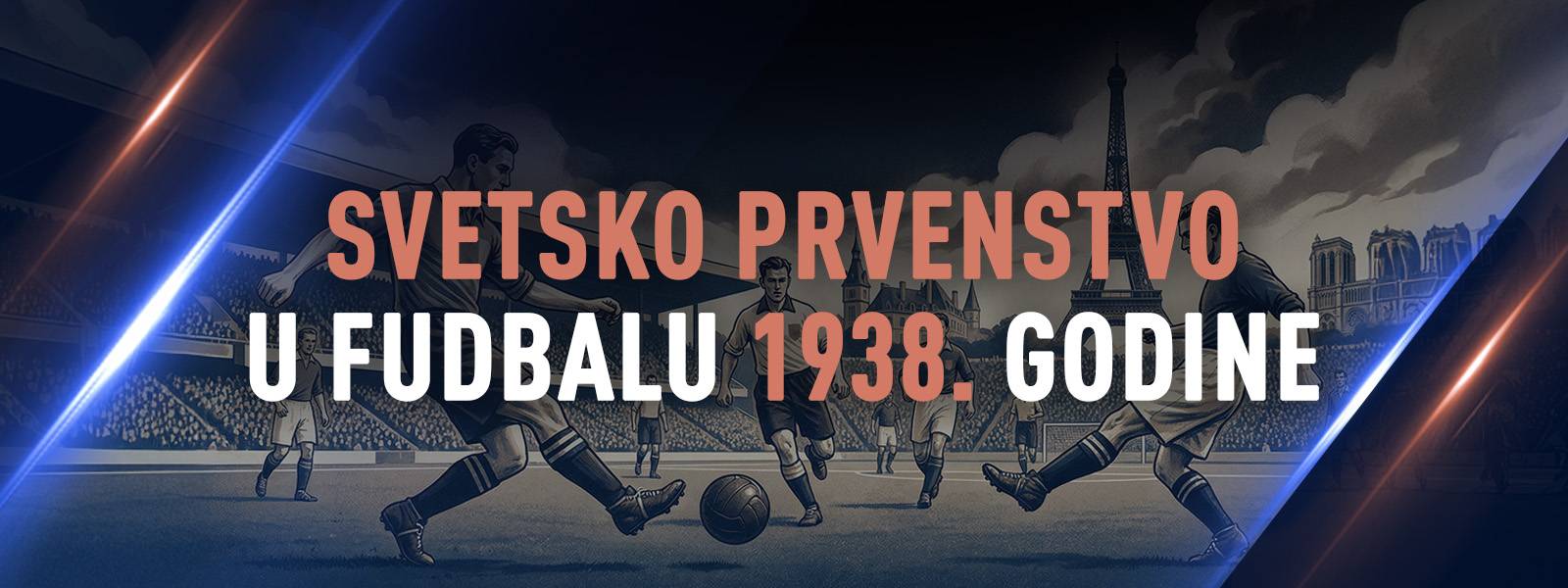
FIFA World Cup 1938
The 1938 FIFA World Cup was held in France from June 4 to June 19 and was the third edition of the tournament. The competition took place amid deep political instability in Europe and growing international tensions that foreshadowed the outbreak of the Second World War. Against this backdrop, football remained a meeting place for nations, while also reflecting the rapidly changing political climate of the time.
Fifteen national teams took part in the tournament after one team withdrew shortly before the competition began, which also affected the tournament format. Italy won the title, becoming the first national team in World Cup history to successfully defend its championship. The 1938 World Cup is remembered for its high level of play, its political context, and for being the last World Cup before a long interruption caused by the war.
Historical and Football Context
Europe was deeply divided in the late 1930s. Political extremism, territorial disputes, and ideological differences shaped international relations. Against this backdrop, France’s hosting of the World Cup made sense from a sporting perspective, but the tournament also carried broader political significance.
By this time, football had become deeply rooted in national identities. National teams represented more than sporting competition; they had also become symbols of national identity. Italy, the reigning world champions, arrived in France determined to defend their title, while many other national teams saw the tournament as an opportunity to establish themselves on the international stage amid an increasingly unstable political climate.
On the field, football continued to evolve toward greater tactical discipline. Differences in playing styles remained evident, but they gradually narrowed as national teams adopted successful ideas and approaches from one another.
Qualifying and the Road to the Final Tournament
The 1938 World Cup featured a qualifying system similar to that used for the 1934 tournament. A total of 37 national teams entered the qualifying competition, with 34 of them competing for 14 places in the final tournament. France qualified automatically as the host nation, while Italy, as the reigning world champions, also had to go through qualifying, as was the case four years earlier.
A significant absence from the tournament was Spain, which was unable to participate because of the Spanish Civil War. Austria also qualified for the championship, but following the Anschluss and its annexation by Germany in March 1938, it withdrew from the competition. Its withdrawal reduced the number of participating teams to 15 and allowed Sweden to advance directly to the quarter-finals without playing a match.
These developments highlighted the extent to which political circumstances shaped the composition of the tournament and, in Austria’s case, directly affected its course.
The Host Country and Tournament Organization
The 1938 World Cup was played across several French cities, including Paris, Marseille, Bordeaux, Lille, Strasbourg, Le Havre, Reims, Toulouse, and Antibes. The final was held in Colombes, near Paris, at the Stade Olympique Yves-du-Manoir, a venue with previous experience of hosting major international sporting events.
The tournament was well organized, building on the experience of previous World Cups. France provided the necessary infrastructure and logistical support, while public interest in the competition was considerable. At the same time, the tournament took place against a backdrop of growing political uncertainty across Europe.
The Course of the 1938 World Cup
Tournament Format
As in 1934, the 1938 World Cup was played as a knockout tournament, with every match serving as an elimination game. If a match ended in a draw, extra time was played. If there was still no winner, the match was replayed, as penalty shootouts were not yet used to decide matches.
This format placed additional pressure on the teams and could encourage a more cautious approach, particularly in the later stages of the tournament.
The Final Stages
Italy maintained a consistent approach throughout the tournament, combining organized defending with efficient attacking and adapting its tactics to different opponents. In the semi-final, Italy defeated Brazil in a match that featured two contrasting tactical approaches and secured Italy’s place in the final.
Hungary, meanwhile, progressed to the final with a strong attacking approach and a series of notable results. Their run reflected the growing technical and tactical sophistication of several European national teams during this period.
The Final and the Battle for the Title
The 1938 FIFA World Cup final was played on June 19 in Colombes, with Italy facing Hungary for the title. The match attracted considerable attention as the two teams competed for the championship.
Italy won 4–2, scoring twice in each half to secure the title. With this victory, the Italian national team became the first team in World Cup history to win two consecutive titles, following its triumph in 1934.
The Tournament’s Most Notable Figures
The 1938 World Cup featured a number of notable players, including several members of the Italian team that had also won the 1934 tournament. Their continued presence in the squad gave Italy a degree of continuity as the team defended its title.
Brazil’s Leônidas da Silva was the tournament’s leading goalscorer, scoring seven goals. His performances made him one of the most prominent individual figures of the tournament and further highlighted the attacking talent on display in France.
Statistics and Interesting Facts
A total of 18 matches were played at the 1938 World Cup, with 84 goals scored. The average number of goals per match was high, reflecting the attacking potential of many teams and a lower degree of tactical defensiveness compared with later tournaments.
The tournament is also remembered as the last World Cup before the Second World War. The next edition was not held until 1950, following a twelve-year interruption. After the long break caused by the war, the World Cup returned with the 1950 FIFA World Cup, marking the return of international football’s biggest tournament to the global stage.
The Place of the 1938 World Cup in Football History
The 1938 World Cup marked the end of the pre-war era of the competition. It further established the World Cup as the leading international football tournament and reflected the growing importance of football on the international stage.
At the same time, the tournament illustrated the close relationship between sport and politics during a period of major political and social change in Europe. For this reason, the championship in France remains one of the most significant and frequently analyzed editions in the early history of the World Cup.