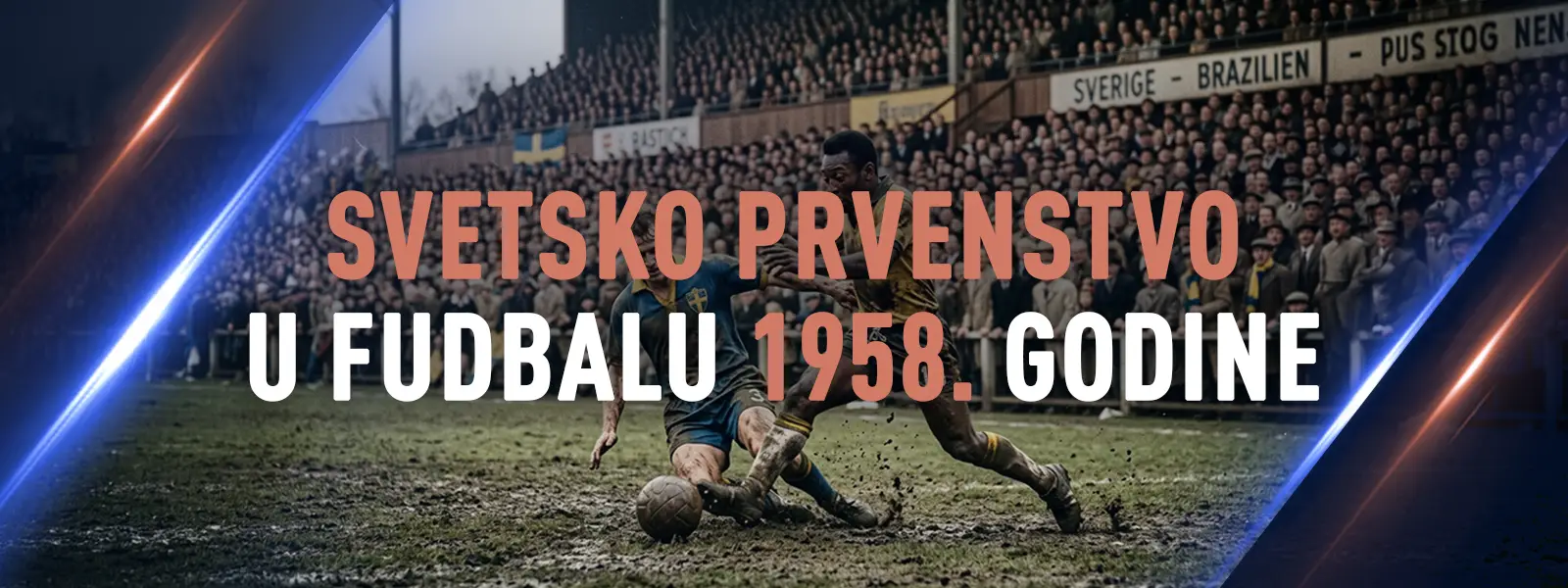
FIFA World Cup 1958
The 1958 FIFA World Cup was held in Sweden from June 8 to June 29 and was the sixth edition of the tournament. The competition took place at a time when international football had already reached a more developed stage, with more clearly defined tactical frameworks, a growing number of world-class players, and increasing global interest among fans. In this sense, the tournament in Sweden is often viewed as a transitional point between the early, formative years of the World Cup and the more modern era of international football.
The 1958 World Cup is remembered for several key features: a large number of high-quality matches, a clear generational shift, and the emergence of players who would leave a lasting mark on the history of the sport. The tournament marked the beginning of a new footballing era while also confirming that the World Cup had developed into a truly global event.
Historical and Football Context
The late 1950s were characterized by relative stability and economic growth across much of Europe. Sweden, which had not been directly affected by the devastation caused by the Second World War, had the infrastructure and organizational capacity required to host a major international sporting competition. Its neutrality and strong sporting tradition made it a suitable host at a time when international cooperation was gradually becoming more firmly established.
From a footballing perspective, the sport had entered a phase of greater specialization in player roles and increasing tactical discipline. National teams were playing more international matches than before, while the differences between European and South American styles of play were becoming less pronounced. Physical preparation, speed, and technical ability were increasingly regarded as inseparable elements of top-level football.
In this context, the 1958 FIFA World Cup brought together different footballing philosophies that were gradually becoming more similar.
Qualifying and Participating Teams
A total of 55 national teams entered the qualifying competition for the 1958 World Cup, although some teams withdrew before or during the qualification process. At the time, this represented a record level of interest in participating in the World Cup.
Through the qualifying process, 16 teams secured their places in the final tournament in Sweden. The host nation qualified automatically, while the remaining places were filled through regional qualifying competitions.
The participants included national teams with varying levels of World Cup experience. Alongside traditionally strong teams from Europe and South America, the tournament also featured sides seeking to build on their progress and strengthen their position on the international stage. This diverse group of participants added to the variety of the tournament.
Host Country and Tournament Organization
The matches of the 1958 FIFA World Cup were played in several Swedish cities, including Stockholm, Gothenburg, Malmö, Helsingborg, Norrköping, Örebro, and Borås. Games were also held in other cities across the country, further highlighting the national scope of the tournament. The final was played at Råsunda Stadium in Stockholm, one of the tournament’s principal venues.
The tournament was organized efficiently, with solid logistics and a clearly defined competition format. Sweden provided consistent playing conditions, while spectator interest remained high throughout the tournament. The competition took place without major organizational problems, reinforcing the reputation of the World Cup as a well-established international sporting event.
The Course of the 1958 World Cup
Tournament Format
The 1958 World Cup used a format consisting of a group stage followed by a knockout phase. Sixteen national teams were divided into four groups of four, with the top two teams from each group advancing to the quarter-finals.
During the group stage, matches were played over the standard 90 minutes, and draws were allowed without extra time. Group standings were determined by points and goal average. If teams remained completely tied, additional play-off matches were held to determine which team would advance. This occurred several times during the tournament.
Group Stage
The group stage featured a series of closely contested matches and several results that demonstrated how evenly matched the teams had become. The favorites generally lived up to expectations, but certain matches indicated that the differences between national teams were no longer as pronounced as they had been in previous decades.
It was particularly noticeable that national teams were becoming increasingly effective at balancing attacking play with defensive organization, contributing to a higher overall tactical standard.
The Knockout Stage
As the tournament entered the knockout phase, the intensity and quality of the matches increased further. The quarter-finals and semi-finals featured high-tempo encounters, tactical battles, and decisive individual contributions.
Brazil demonstrated remarkable consistency and efficiency during the latter stages of the tournament. Its style combined technical quality, speed, and tactical discipline, allowing the team to establish itself as one of the leading contenders for the title.
Meanwhile, the host nation, Sweden, reached the final, relying on organized play and the support of the home crowd, which further heightened interest in the closing stages of the competition.
The Final and the Battle for the Title
The final match of the 1958 FIFA World Cup was played on June 29 in Stockholm. Brazil and Sweden met in the final in a match that held considerable significance, both on the field and for the tournament as a whole.
Brazil won 5–2 to claim its first World Cup title. The victory marked a historic moment for the Brazilian national team and established Brazil as one of the leading forces in world football.
The final was an entertaining, attack-minded contest, featuring seven goals and plenty of open play. It further enhanced the tournament’s reputation as one of the most impressive World Cups held up to that point.
Most Notable Figures of the Tournament
The 1958 FIFA World Cup was notable for the emergence of a new generation of footballing talent. Among them, the young Brazilian player Pelé stood out in particular. Despite his age, he played a significant role in the latter stages of the tournament, especially during the knockout phase. His performances in the knockout rounds made a lasting impression and marked the beginning of what would become an extraordinary career.
France’s Just Fontaine was the tournament’s top scorer, finishing with 13 goals. His tally remains one of the most remarkable individual achievements in World Cup history and a record that has still not been surpassed in a single tournament.
Statistics and Interesting Facts
A total of 35 matches were played at the 1958 FIFA World Cup, with 126 goals scored. The average number of goals per match was high, reflected the attacking style of many of the games.
The tournament is also remembered for the growing reach of television coverage, which brought the World Cup to audiences in a significantly larger number of countries and helped further expand its international appeal.
The Place of the 1958 World Cup in Football History
The 1958 FIFA World Cup occupies an important place in football history as a tournament that helped usher in a new era for the game. It demonstrated how football was evolving toward greater speed, technical quality, and international recognition.
At the same time, the tournament in Sweden showed that the World Cup was more than just a sporting competition. It was becoming a cultural phenomenon that connected audiences and players from different parts of the world. This development continued at the 1962 FIFA World Cup, which introduced a new generation of players and further strengthened the importance of the world’s biggest football tournament. The 1958 World Cup therefore remains an important milestone in the history of the game.