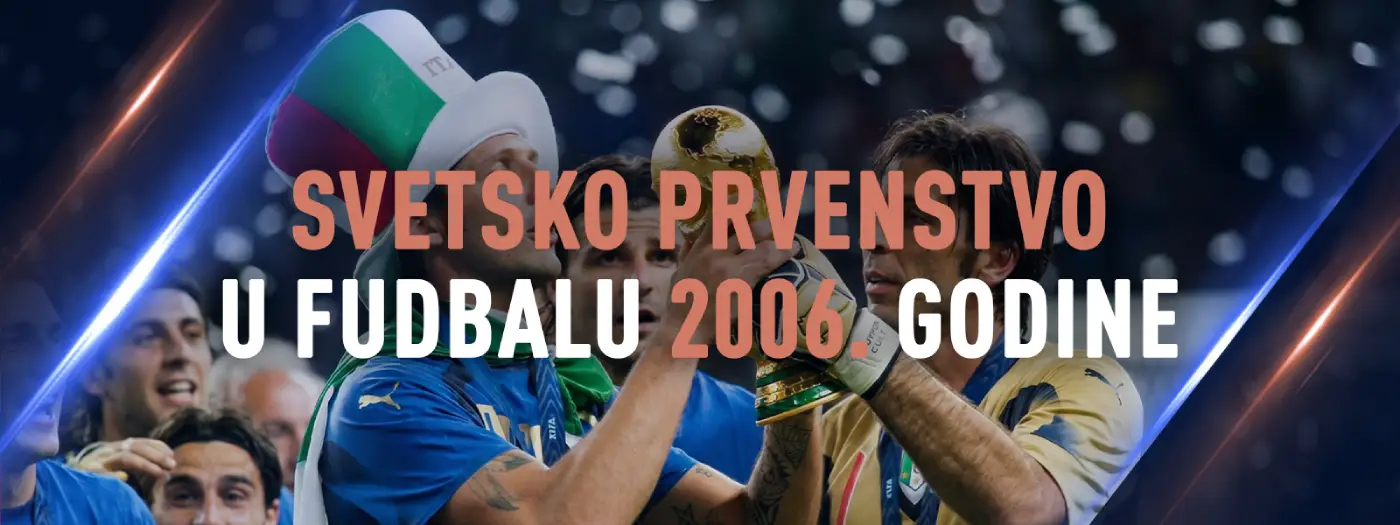
FIFA World Cup 2006
The 2006 FIFA World Cup was held in Germany from June 9 to July 9 and was the 18th edition of the tournament. The competition is remembered for its outstanding organisation, tactically disciplined football and a dramatic final that featured one of the most controversial moments in World Cup history.
The World Cup in Germany is often described as a tournament that combined traditional European stability with global competition. While it did not revolutionise the way the game was played, the tournament highlighted the balance between attacking ambition and tactical discipline. It was a competition defined by strong emotions, legendary players and a dramatic conclusion that left a lasting impression on football fans around the world.
Historical and Organisational Context
Germany was awarded the right to host the tournament in 2000, beating bids from South Africa, England, Morocco and Brazil. The vote was decided by a narrow margin and attracted considerable international attention.
The organisation of the tournament was widely regarded as highly successful. Modern stadiums, an efficient transport network and well-coordinated logistics allowed the competition to run smoothly. Matches were played in 12 host cities, including Berlin, Munich, Dortmund, Hamburg, Cologne, Stuttgart, Frankfurt, Gelsenkirchen, Hanover, Leipzig, Nuremberg and Kaiserslautern.
The tournament had a significant social impact in Germany. The atmosphere was often described as a “summer fairytale”, with public spaces filled with supporters of different national teams, while the World Cup contributed to a sense of openness and international connection.
Qualifying and Tournament Participants
A total of 198 national teams took part in the qualifying process. The final tournament retained the 32-team format, with the teams divided into eight groups of four.
Hosts Germany qualified automatically, while defending champions Brazil had to go through the qualifying process, as FIFA had abolished automatic qualification for the reigning champions after the 2002 World Cup.
The tournament brought together a generation of players who shaped the first decade of the 21st century. Ronaldo, Ronaldinho, Kaká, Zinedine Zidane, Thierry Henry, Andrea Pirlo, Francesco Totti and many others took part, adding further quality and star power to the competition.
The Host Nation and Tournament Organisation
By hosting the World Cup, Germany aimed to showcase its modern infrastructure and ability to stage a major international sporting event. Stadiums were almost always full throughout the tournament, while average attendance was among the highest in the history of the competition.
Public screenings of matches on giant screens in city centres became one of the defining features of the tournament. This practice later became standard at major international sporting events.
The 2006 World Cup
Tournament Format
As in previous editions, 32 national teams were divided into eight groups of four. The top two from each group advanced to the Round of 16.
In the knockout stage, matches went to extra time if the scores were level after 90 minutes, followed by a penalty shootout if the winner could not be decided after extra time.
Group Stage
The group stage featured more dynamic football than the 2002 tournament. In the opening match, Germany defeated Costa Rica 4–2, setting the tone for a more attacking and high-scoring tournament.
Argentina recorded a convincing 6–0 victory over Serbia and Montenegro, one of the most emphatic results of the tournament. Brazil progressed from the group stage unbeaten, while Spain demonstrated their technical quality.
Several teams with high expectations, including the Netherlands and England, put in solid performances but failed to establish complete dominance.
The Knockout Stage and Key Moments
The Round of 16 produced a series of closely contested matches. Italy defeated Australia 1–0 with a late penalty.
One of the tournament’s most exciting matches came in the quarterfinal between Germany and Argentina. With the score still 1–1 after extra time, Germany prevailed in the penalty shootout.
Italy defeated hosts Germany 2–0 after extra time in the semifinal, scoring both goals late in the match. In the other semifinal, France defeated Portugal 1–0 after Zinedine Zidane converted a penalty.
The Final and the Battle for the Title
The final was played on July 9, 2006, at the Olympic Stadium in Berlin, between Italy and France.
France took the lead through a Zinedine Zidane penalty, while Italy equalised through a goal from Marco Materazzi. The score remained 1–1 after extra time.
During extra time, Zidane was sent off after headbutting Materazzi. The match was decided by a penalty shootout, with Italy winning 5–3 to claim their fourth World Cup title.
The Tournament’s Standout Players
Fabio Cannavaro led Italy’s defence throughout the tournament and was one of the key factors behind the team’s success. Gianluigi Buffon also played a crucial role in goal.
Miroslav Klose finished as the tournament’s leading scorer with five goals. Zinedine Zidane had a decisive influence on France’s performances despite the controversial ending to his international career.
Many of the players who stood out at the 2006 World Cup continued to play key roles for their national teams in the following years. Germany’s emerging generation was particularly notable, producing an impressive performance four years later at the 2010 World Cup and laying the foundations for a team that would eventually go on to win the World Cup.
Statistics and Interesting Facts
The tournament featured 64 matches and produced 147 goals, with an average of 2.30 goals per match.
The tournament was also notable for the high number of yellow and red cards, including the highest number of sendings-off at a World Cup up to that point.
The 2006 World Cup highlighted the growing importance of physical preparation, tactical discipline and mental strength in modern football.
The Legacy of the 2006 World Cup
The 2006 World Cup combined organisational success with sporting intensity. The tournament remains a symbol of strong emotions, while also demonstrating the continued competitiveness of European national teams within the global game.
The World Cup in Germany is remembered as a tournament in which details, discipline and mental strength determined the outcome of the most important matches.